training included
An agent team handles the pulling, the checking, and the first-pass analysis. What reaches the marketing team is a read on the week and a ranked list of what to change. Their hours go into lifting Meta ROAS, getting tests live, and building the strategies that never made it off the list.
Five hours a week, back with the people whose judgment moves the number, and spent deciding what to change instead of documenting what already happened.
AptDeco is the peer-to-peer marketplace for quality used furniture, with listings, pickup, and delivery handled end to end. Paid social led by Meta is a core growth channel, which means when their Meta ads have a bad month the whole company has a bad month.
The marketing team is senior and small, which is the usual shape at this stage. Every week the same grind had to happen before anyone could think. Someone had to pull the data out of Meta, work out which movements were real and which were noise, and keep going until the week’s story held together well enough to act on. By the time anyone came up for air with something worth deciding, the thinking time was already spent.
So one of two things happened. Either the analysis got done properly and it ate the front of the week, or it did not get done at all and the week's decisions came off a surface read of a dashboard.
So the best thinking of the week went into the weeds of one channel, which left no bandwidth for the strategy behind it or for testing anywhere else.
Most of what makes a system like this work gets decided before there is anything to look at. I spent the first week learning how AptDeco actually makes decisions, and everything built after that lived inside that context.
I read all of it, from big-picture brand strategy down to how they run Meta specifically. Their docs, their funnel data, their targets, plus two calls to ask what the numbers did not explain. Everything built after this sat inside that context, and the agents were trained on it too.
Their weekly rhythm was real, but it lived in habits and side conversations rather than a written process. I turned it into an actual workflow and left every decision point where a person was already making the call.
I built the agents and the workflows that connect them. They carry shared memory of what has already been tried, hand work between each other, and get sharper as that record grows. All of it was scored and tested against live account data and the goals AptDeco is actually measured on.
Their team learned to run it, question it, and extend it, testing it against the weeks they already knew the answers to.
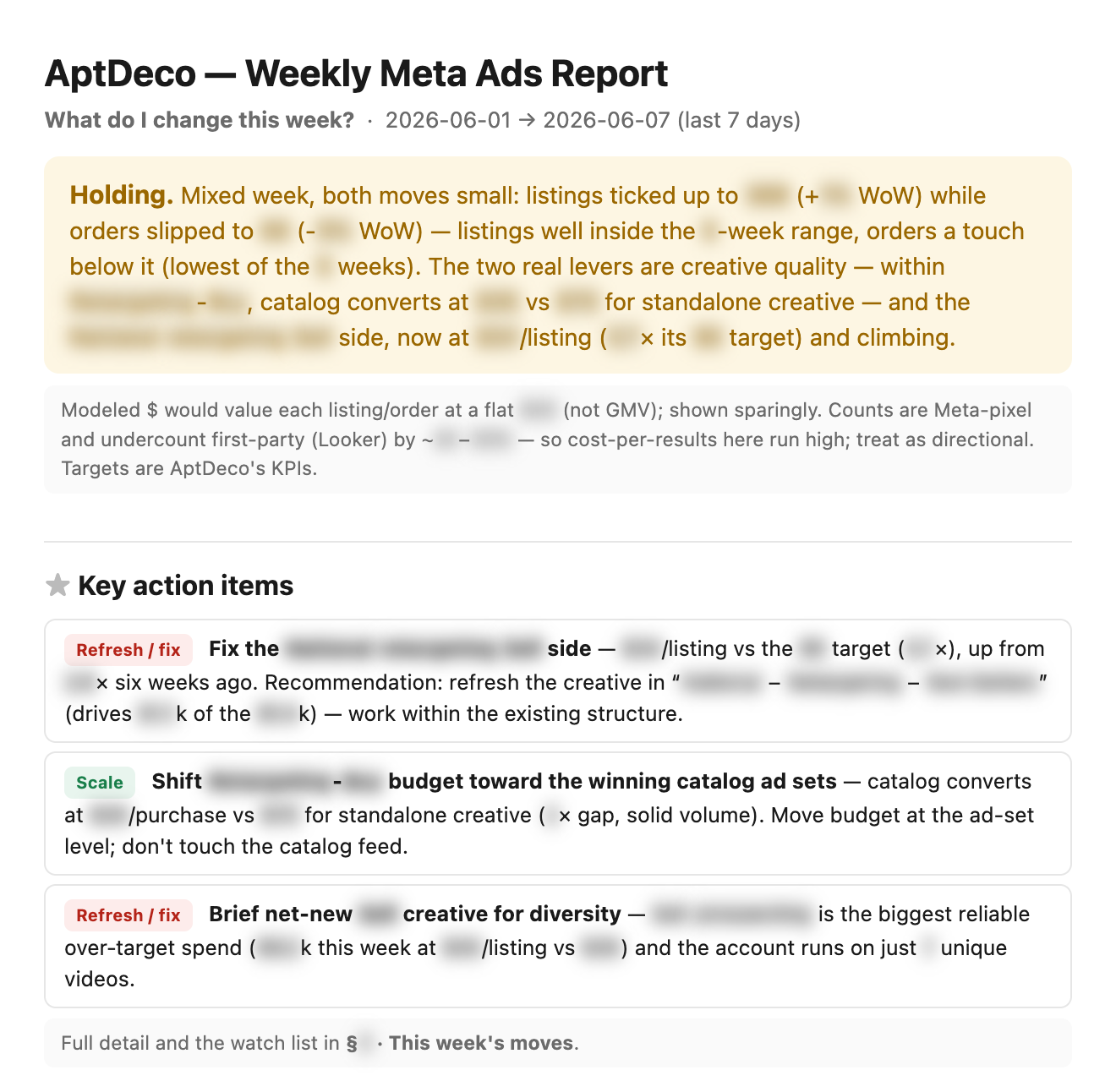
A weekly automation pulls fresh data from the Meta API, and the agent team turns it into a read on the week with ranked recommendations, plus shippable, on-brand creative. A person stays in the loop wherever judgment matters.
Pulls last week's numbers from the Meta API, writes the analysis, and recomputes every figure twice before it is trusted.
They brain-dump what changed, what to push, what to skip. Their judgment steers the week, and the system brings the evidence.
Merges the report's evidence with their direction into one ranked plan: creative briefs plus an account-change punch-list.
Builds the next round of ads off the plan, self-QC'd creative kits and copy, and makes the approved account changes.
Logs everything that ran, including which new ads went live, and carries priorities forward so the system keeps getting better.
And the loop compounds. Next week starts smarter than the last.
Every week leaves something behind: what got approved and what got cut, which angle beat which, where the team overrode a recommendation and why. All of it is an input to the next run, so the analysis arrives already knowing what this brand has tried and how the market answered. A new hire needs months of watching to build that judgment. The system opens every Monday with all of it.
Reads the whole account every week and writes the report, so Monday starts with the team already knowing what happened and why it matters.
Pressure-tests the strategy. Checks that the week's conclusions ladder to the brand's actual goals, and that the priorities are ranked by what moves the business.
Separates signal from noise. Checks sample sizes, comparison validity, and attribution caveats, so a quiet week never gets read as a trend and the data keeps its integrity.
Reads the insights, knows what works for the brand, and tracks what is winning on Meta more broadly right now. Writes the briefs, then sends them to a generation platform to make the videos and images.
Writes the ad copy in the brand's voice, matched to each brief.
Recompute every number independently, blind to the work they are checking, before anything ships.
Read that list again as a hiring plan. A performance marketer, a CMO, a data scientist, a creative director, and a copywriter, plus two more whose entire job is checking the first five. No consumer startup at this stage is staffing that. AptDeco has it running every week.
You have made a great hire before, so you know the feeling. Work that mattered but ate your week goes to someone you trust, and your own attention moves up a level. You stop producing the inputs and start working on the decisions.
An agent team does real strategic work. It reads the whole account, pressure-tests the week’s conclusions against the business goals, separates signal from noise, and arrives with a ranked point of view. It also carries the repetitive, time-consuming half: the reporting, the first-pass analysis, the creative drafts, the account housekeeping. What it never does is make the final call. That stays with the people whose job it is. The hours come back, and they go where they compound, into lifting return in the channel and into the ideas that never made it off the list.
“Most AI marketing solutions are built by engineers who understand the tech but have no real context for how marketing works. Justine's been in my seat. She got fluent in our strategy fast, built around our whole funnel instead of one tactical slice, and gave me back a real piece of my week: an AI thought partner plus five specialized agents that run as my performance marketing and creative team.”
Nothing here is specific to furniture, or to Meta. The shape is a channel your revenue leans on, a weekly grind sitting in front of every decision, and a team too small to do both well. That describes most of the consumer companies I talk to.
If we haven't met, I'm Justine. After 15 years running consumer marketing in-house, I now build these systems for high-growth startups. It usually starts in the same place: a channel or a strategy that deserves real investment, and a team that is already tapped out.
So you are probably already thinking of what that looks like for your team. The part of the strategy that has never worked the way it should, or the one that works but eats the hours you needed for everything else.
Let's talk it through in twenty minutes. Tell me what you are dealing with and I'll tell you how it would work as an agent team, whether you hire me to build it or build it yourself.